Browse Our Books
You can browse our books easily with any of the following filters, hover over the filters or their titles to see their descriptions.
Reading Level
Categories
Or you can use quick search or switch to advanced search for better results...
Search Results (Found 1283 results)
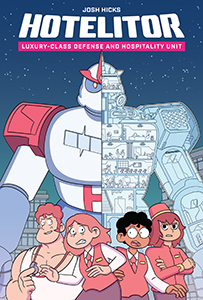
Hotelitor: Luxury-Class Defense and Hospitality Unit 
Hotelitor is the finest hospitality craft in its colony, equipped with jet feet, a hyperspace engine, and single, double, and adjoining rooms. When a giant alien attacks the ship, Hotelitor's surviving guests and staff find themselves stranded in deep space. There, 18-year-old intern Anna Green must take charge. Alongside her fellow entry-level service workers, she'll try to control the chaos while rival factions emerge, wealthy VIPs seize hotel resources, and the musician-in-residence develops
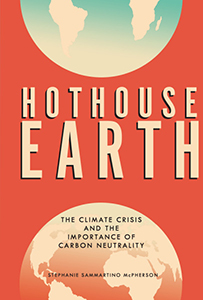
Hothouse Earth: The Climate Crisis and the Importance of Carbon Neutrality
As hurricanes, droughts, floods, and wildfires are increasing in regularity and intensity, climate change can no longer be ignored. Melting permafrost, forest dieback, ocean acidification, and other processes are creating positive feedback loops which could, if not aggressively and quickly addressed, spiral out of control and take global warming past the point of no return. Hothouse Earth examines how science, politics, and social justice must all be part of the equation to counteract climate ch
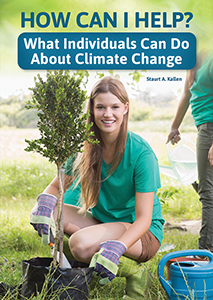
How Can I Help? What Individuals Can Do About Climate Change
The climate is changing and the causes are well understood. How Can I Help? What Individuals Can Do About Climate Change provides common sense, eco-friendly solutions for readers who wish to take positive actions to lower their carbon footprints.

How High-Tech Changed the World
Our world has been transformed by amazing high-tech inventions, but how do these incredible technologies work, who invented them, and how have they changed the way we live? Readers discover all this and more in this exciting and informative series. How High-Tech Changed the World is the ultimate guide to the science, the tools, and the people behind the tech revolutions that transformed our world.

How Many Letters Are In Goodbye?
I'm crying again, Mum. I'm crying because I don't know how many letters I have to write to say goodbye to you. More than anything, I wish I knew. Seventeen-year-old Rhea Farrell has scars from a childhood accident in which she lost her arm. But she also carries scars that aren't so visible...the loss of a mother she hardly remembers, the impact of her father's drinking, and her confusion and pain around accepting her sexuality. When Rhea runs away, she turns to the person she's always wished she
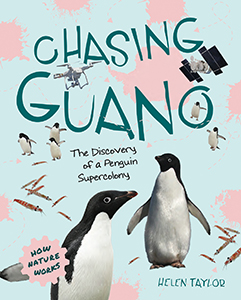
How Nature Works
How Nature Works books employ vivid photography and text (3,000 © 4,000 words) to ask questions of the natural world. These inquiry-based books, designed to stimulate active minds, include two Junior Library Guild selections, starred reviews, three NSTA Outstanding Science Trade Books of the Year, and an Audubon Magazine EditorÎs Choice.

How Science Changed the World
Scientific discoveries and inventions have the power to change lives. Some-such as electricity, automobiles, and the Internet-have altered the world in innumerable ways. The new series, How Science Changed the World, explores some of the greatest scientific and technological achievements in human history-along with the changes (positive and negative) brought about by these innovations. This series is a mix of science and technology, history, and social history-on a global scale.
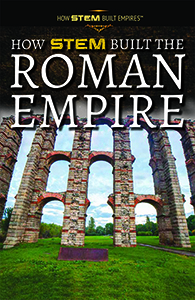
How STEM Built Empires
Science, technology, engineering, and mathematics, much better known as the STEM fields, have come to the forefront of global conversation in the 2010s, but the power of STEM stretches all the way back to the ancient world. The largest empires in history laid their foundations using cutting-edge STEM principles. Often, these advancements led to even greater successes in war, architecture, and expansion. No matter the root cause, one thing is certain: without STEM, the great ancient empires would
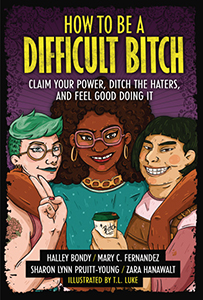
How to Be a Difficult Bitch: Claim Your Power, Ditch the Haters, and Feel Good Doing It
In the past, being a ""difficult bitch"" was bad. Girls weren't supposed to call people out for their BS, stand up for themselves, or do their own thing. This book embraces the insult with irreverent humour, encouraging readers to be themselves no matter what, including an exploration of the ways this phrase can be interpreted differently among people of different backgrounds. Being a powerhouse is a choice. It's a lifestyle. It's a code of ethics. It takes work, a thick skin, and perseverance.
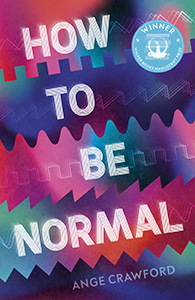
How to Be Normal
Astrid is about to start her last year of high school. And her first. When her dad loses his job, Astrid's homeschooling comes to an end. Until now, she has lived within the confines of a tightly controlled, contracted world where there's no room for anything . . . except following her father's rules and pretending that everything is normal. As Astrid and her mom tentatively expand their world, they struggle to break free of their ingrained wariness and self-doubt. But with hope, new friends, an